Studio notes · Measuring clay
Measure wet clay and estimate its later size
Measure a wet pot, choose a shrinkage rate for the stage you want to predict, and read its estimated later size without compensating twice.
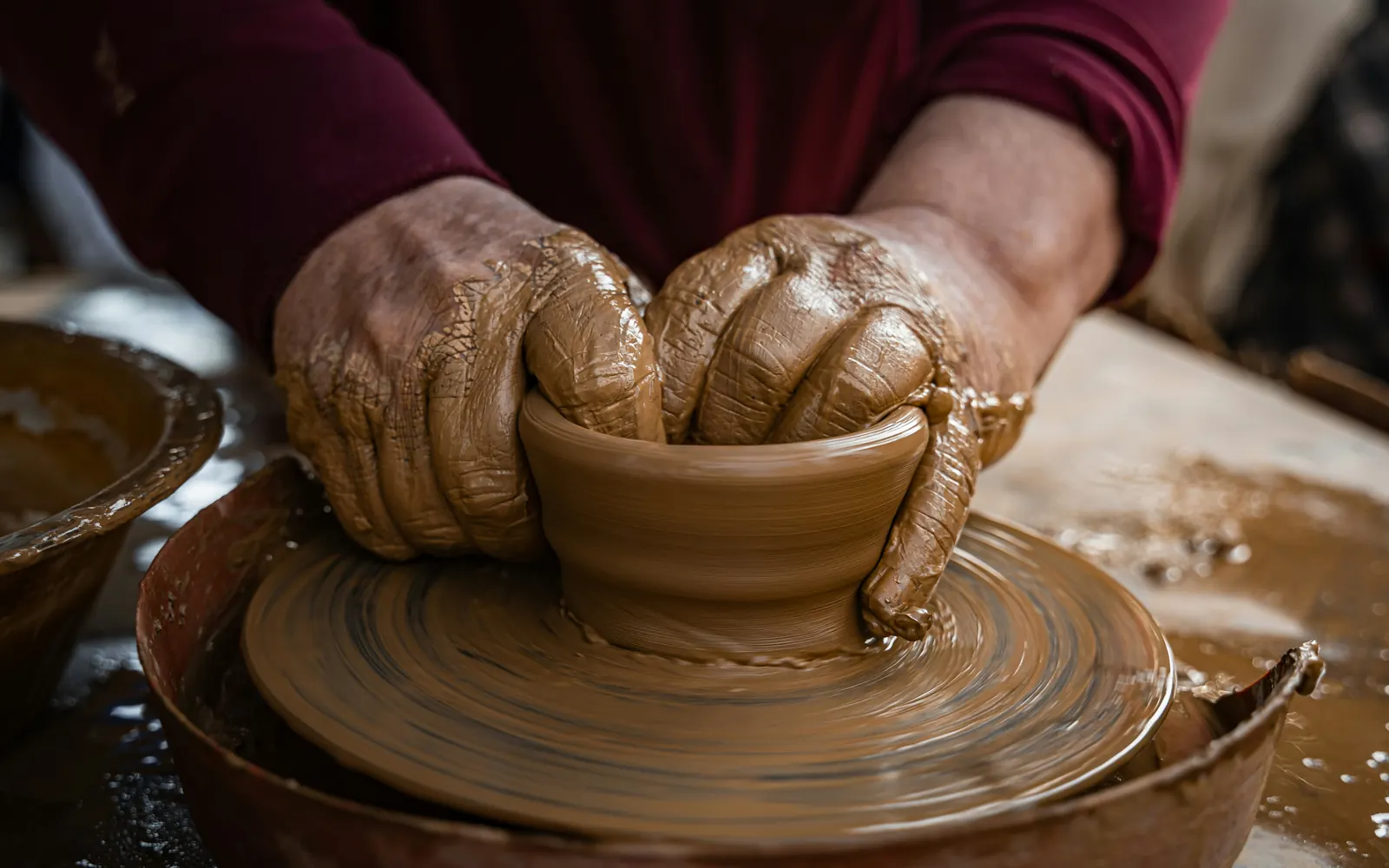
A bowl can look generously sized on the wheel and rather less generous once it reaches the cupboard. A shrinkage ruler helps answer the question while the clay is still wet: how big is this likely to be later?
I like to keep two numbers beside that question: the size now, and the estimated size at a named stage. Otherwise, a note saying “7.087 in” is surprisingly easy to misunderstand.
Decide what “later” means
Choose the endpoint before choosing the percentage:
- Bone-dry: fully dried but still unfired. Use a wet-to-bone-dry rate.
- Bisque: after the first firing in a two-firing process. Use a wet-to-bisque rate for that firing.
- Glaze-fired: after the glaze firing. Use a wet-to-glaze-fired rate for the intended firing process.
Those rates are not interchangeable. A supplier's figure labelled “firing shrinkage” may describe only the change from dry clay to fired clay, leaving out the drying that your wet pot still has ahead of it. Digitalfire's shrinkage test records drying and firing shrinkage separately for precisely this distinction.
Match the rate to the clay body, its starting moisture state and how it was formed, as well as the firing conditions for a fired prediction. If the starting and ending stages of your figure are unclear, pause here: choosing a shrinkage percentage will help you establish what it describes.
Leather-hard clay, firm enough to handle but not fully dry, has already changed since it was freshly formed. Don't apply a full wet-to-fired rate to it as though all that shrinkage were still to come.
Measure a dimension you can find again
For a bowl, “width” might mean the outside of the rim, the inside opening or the widest part of the belly. Pick the one that answers your question, and write it down. An outside diameter cannot tell you the size of the opening.
Stop the wheel before measuring. Use an ordinary ruler first if you want to record the actual wet size alongside the prediction.
For a straight span you can reach safely, align the ruler with that span without pressing it into the clay. For an awkward rim or opening, use suitable calipers to take the distance gently, then transfer their unchanged opening to the ruler. Don't squeeze soft walls to get a reading.
Measure a diameter straight across the centre, not along the curved wall. Take another diameter at right angles to the first if the rim is not quite round; keep both readings rather than hiding the difference in an average. For height, identify the base and rim points rather than accidentally including the bat beneath the pot.
These are linear measurements: lengths, widths and heights. A linear shrinkage percentage is not a percentage reduction in the bowl's capacity.
Read the prediction, not another wet measurement
For this method, use a compensated scale whose labels represent later size when laid against wet clay. Its labelled units are physically wider apart than ordinary units, so a wet span gives a smaller number: the predicted later dimension. Liz Denys's shrinkage-ruler guide describes this direct-reading approach; don't assume every tool uses that arrangement.
Choose the matching percentage and units, find the scale's zero reference, and align it with one endpoint of your wet measurement. Read the other endpoint on that same scale. Don't assume the physical end of the ruler is zero, or that another scale alongside it has the same purpose; check the instructions for the ruler you have.
That compensated reading is already the prediction. Don't subtract the shrinkage percentage from it again.
For a quick sense check, if your wet-to-glaze-fired rate is 12%, an actual 10 cm wet span should read an estimated 8.8 cm glaze-fired on a matching direct-reading scale. A shrinkage-scale label of “10” therefore does not mean an ordinary 10 cm physical span. If the scale's meaning is uncertain, check its calibration and direction before trusting it.
The same bowl, measured with an ordinary ruler
An ordinary ruler and a calculation work just as well if you don't have a matching shrinkage scale. Use this route too if your wet span extends beyond the scale's usable marks; don't treat the ruler's physical length as its measuring capacity.
Later size = wet size × (1 − shrinkage percentage ÷ 100)
Suppose a bowl's outside rim diameter measures approximately 7.874 in wet, and a representative test for that clay and firing process gives 12% wet-to-glaze-fired linear shrinkage. This is an illustrative rate, not a recommendation for every clay.
The remaining fraction is 0.88, so:
7.874 in × 0.88 ≈ 6.929 in estimated glaze-fired outside rim diameter.
A matching direct-reading shrinkage scale would give the same estimate, as closely as its markings allow you to read. Record it as “7.874 in wet → about 6.929 in glaze-fired”, not simply “6.929 in”. It does not predict the bisque diameter or the inside opening.
Keep the note until the kiln is unloaded
Keep a short record of the clay, its wetness and forming method, the rate and its source, and the intended drying and firing conditions. Then measure the same endpoints with an ordinary ruler once the piece reaches your chosen stage and, if fired, has cooled.
Watch for changes that aren't shrinkage: trimming away the base changes height, reshaping a rim changes diameter, and glaze on a measuring surface can affect the finished reading. Warping can change the shape even when the shrinkage estimate is reasonable.
On that 7.874 in wet bowl, a one-percentage-point difference in shrinkage changes the prediction by approximately 0.079 in. That's worth remembering before treating a calculated decimal as a promise of fit. For dimensions that really matter, use your own shrinkage tests and check a representative piece before repeating a batch. Keep the predicted and actual sizes together; the difference is useful information for the next pot.